AIMLeNS — AI and Machine Learning in the Natural Sciences
AIMLeNS (Artificial Intelligence and Machine Learning in the Natural Sciences) is a research group at the Data Science and AI division of the Department of Computer Science and Engineering, Chalmers University of Technology, Gothenburg, Sweden. The group is led by Associate Professor Simon Olsson and works at the interface of AI/machine learning and the natural sciences.
Our main research areas are:- AI and molecular simulations: We develop generative AI surrogates for molecular dynamics that bridge to experimentally observable time-scales, including Boltzmann generators, flow-matching methods, and implicit transfer operators.
- Generative AI for inverse molecular design: including design of small-molecule therapeutics, biologics, vaccines, and antibodies.
AIMLeNS is a tight-knit team of computer scientists, chemists, physicists, and mathematicians working collaboratively. Our focus is on developing practical methods that blend traditional disciplines with modern machine learning and AI technologies to effectively address large-scale problems in the natural sciences.
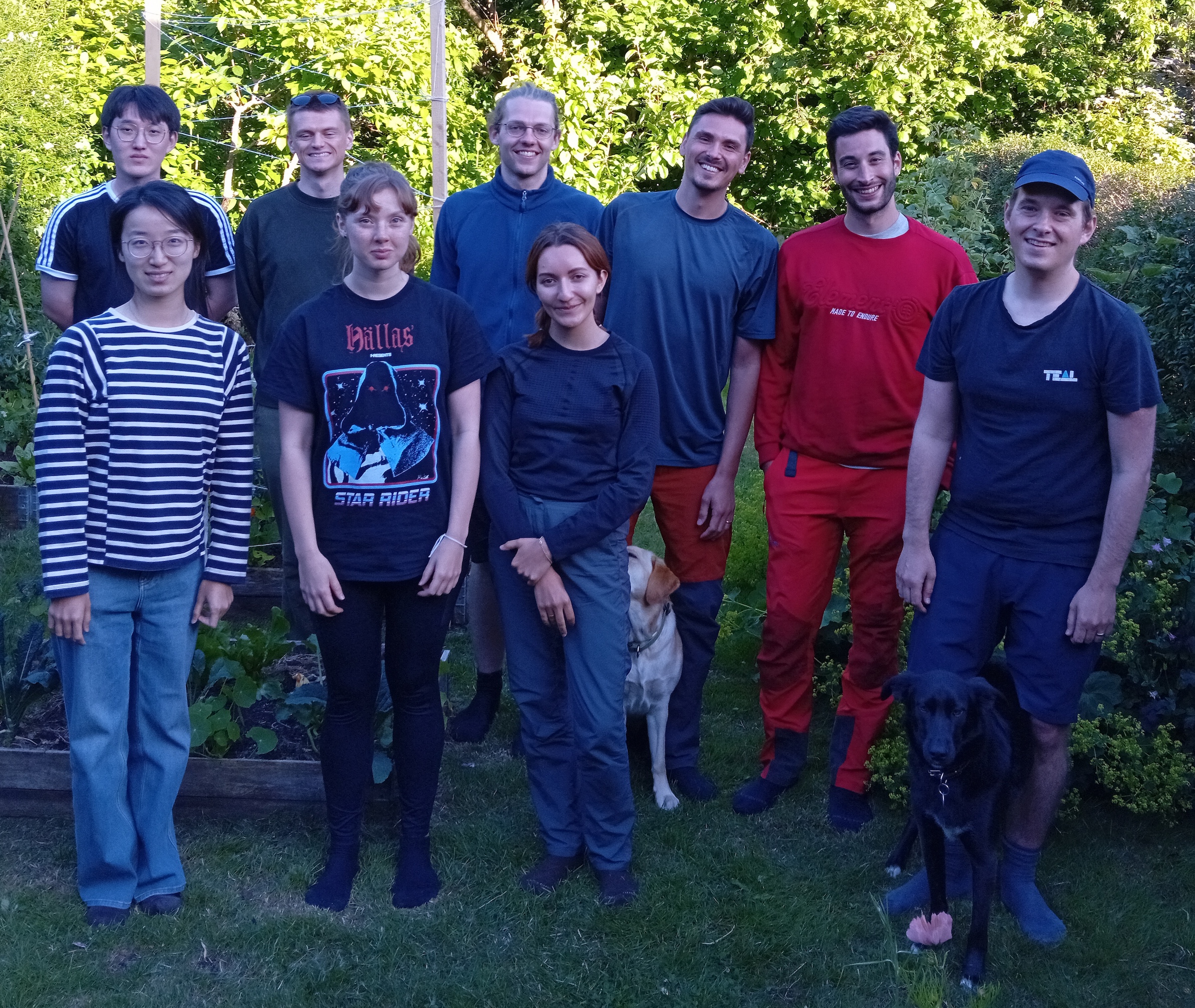
AIMLeNS, June 2025.
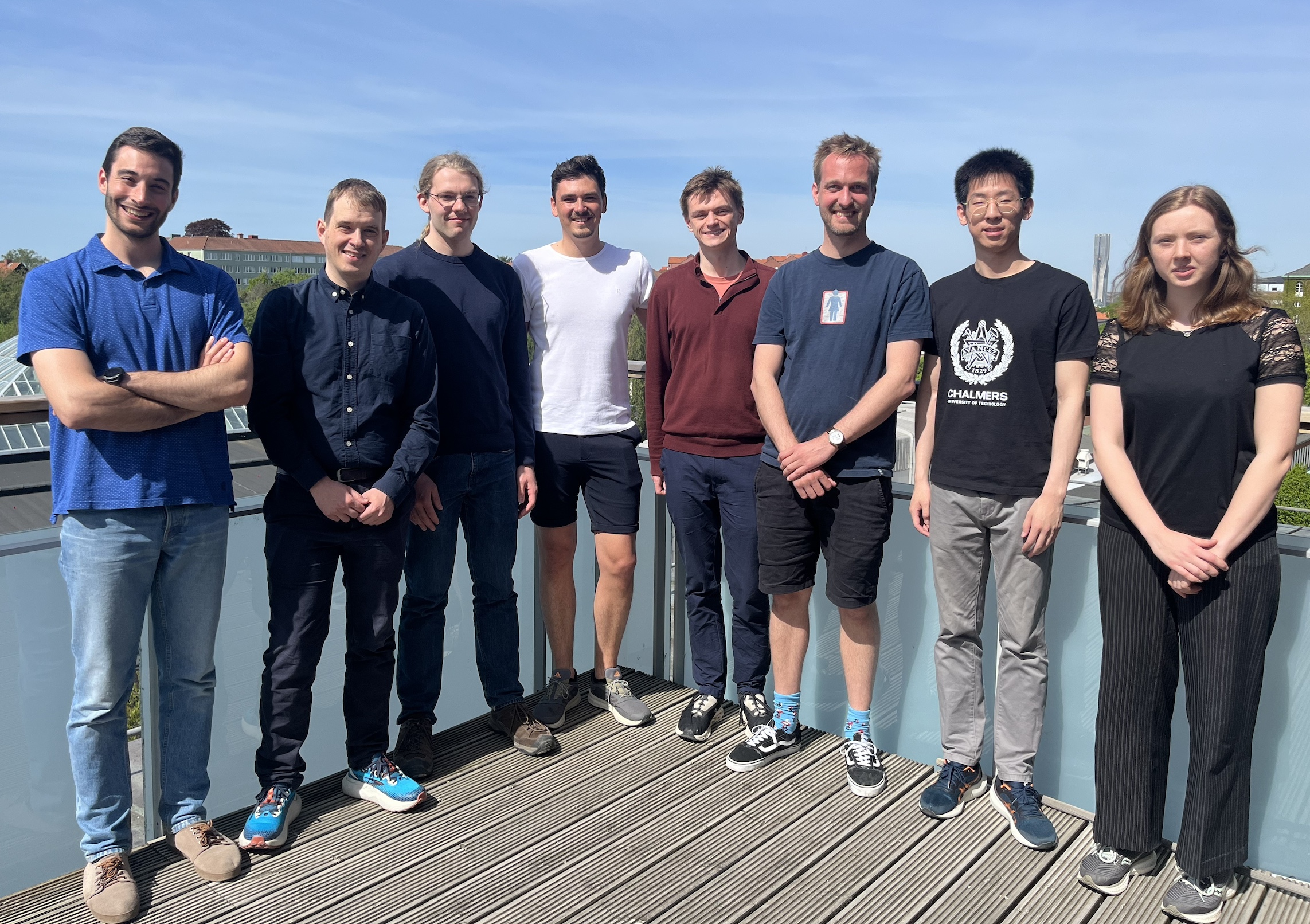
AIMLeNS, May 2024.
AIMLeNS is funded by:
- Knut and Alice Wallenberg Foundation project grant
- Wallenberg AI, Autonomous Systems and Software Program (WASP)
- Data-Driven Life Science (DDLS)
- Wallenberg Centre for Quantum Technology (WACQT)
- AstraZeneca AB
Frequently asked questions
What is AIMLeNS?
AIMLeNS is the AI and Machine Learning in the Natural Sciences research group at Chalmers University of Technology in Gothenburg, Sweden. The lab is led by Associate Professor Simon Olsson and is part of the Data Science and AI division of the Department of Computer Science and Engineering.
Who is Simon Olsson?
Simon Olsson is an Associate Professor at Chalmers University of Technology and the head of the AIMLeNS lab. He works on machine learning for molecular simulation and generative AI for molecular design, and is known for contributions to Boltzmann generators (Science 2019), implicit transfer operators (NeurIPS 2023, ICLR 2025, Sci Adv 2026), and generative molecular dynamics more broadly (Curr. Opin. Struct. Biol., 2026). He is a WASP Fellow, ELLIS Member, recipient of an ERC Consolidator Grant (2025), and the inaugural recipient of the ICTP-IBM Brahmagupta AI Prize (2025).
What does the AIMLeNS lab work on?
AIMLeNS develops machine-learning methods for two main problems: (1) generative AI surrogates for molecular dynamics that bridge femtosecond simulations to experimentally observable time-scales, and (2) inverse molecular design of small-molecule therapeutics, biologics, vaccines, and antibodies.
How do I apply to join the AIMLeNS lab?
Open PhD, postdoc, and master-thesis positions are announced on the team page and on Chalmers' official job portal. For research collaborations or other inquiries, contact Simon Olsson at simonols [at] chalmers [dot] se.